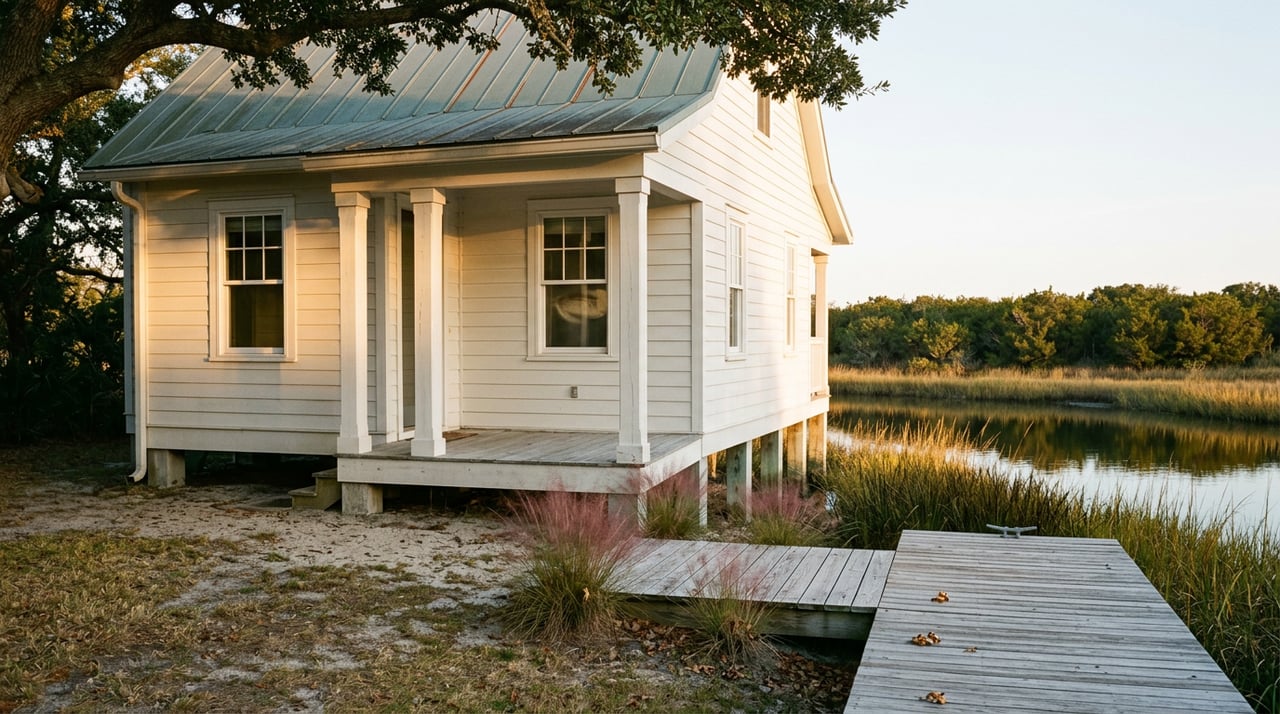
You're standing on a bulkhead on Core Sound, and the house two doors down has a pier reaching out to eight feet of water with a boat lift bolted to the end of it. The property you're touring has the same shoreline, the same view of the Cape Lookout Lighthouse, the same general angle to the channel. So the question in your head is simple: can I build one of those too?
That's the wrong question. The right one is whether your specific parcel, with its specific water depth, its specific riparian lines, and whatever protected habitat happens to sit just offshore, can support a permit application that gets approved. The answer has nothing to do with what's already standing next door.
The Permit Follows the Parcel, Not the Shoreline
North Carolina's Coastal Area Management Act, passed by the General Assembly in 1974, governs construction in the state's 20 coastal counties, Carteret among them. Most new docks, piers, and boat lifts built into estuarine or public trust waters need authorization from the North Carolina Division of Coastal Management before a shovel goes in the ground.
The part buyers underestimate is that CAMA review happens parcel by parcel. Two shorelines that look identical from a boat can carry completely different permitting outcomes because the water depth differs, the riparian corridor is narrower on one lot than the other, or a navigation channel bends slightly closer to one property line. An existing structure next door confirms that a dock was approved for that lot, under whatever conditions applied at the time it was permitted. It confirms nothing about the lot you're buying.
This distinction matters more on Harkers Island than in most Crystal Coast neighborhoods, because the island sits surrounded by Back Sound and Core Sound, both of which carry environmental designations that add review layers before a pier design even reaches the setback rules everyone assumes are the whole story.
Three Permits, Three Timelines
Not every dock triggers the same process. The tier depends on the size and scope of the project.
| Permit Type | Typical Use | Processing Time | Fee |
|---|---|---|---|
| General Permit | Standard residential docks, piers, boat lifts | 14 to 30 days | $100 to $400 |
| Minor Permit | Single-family construction not covered by a general permit | 25 days once the application is complete, under state rule | Varies by project |
| Major Permit | Large-scale projects over 20 acres or 60,000 square feet of construction | Reviewed by as many as 10 state and 4 federal agencies | Starts around $475 |
Most single-family dock projects on Harkers Island fall under the general permit, which is the fastest track. But "most" is doing real work in that sentence. If the proposed dock needs to cross submerged aquatic vegetation, sits near a shellfish lease, or falls inside a designated nursery area, the field representative from the Division of Coastal Management may require a different structure entirely, elevated decking, a longer setback, or a redesign that changes what the buyer thought they were purchasing.
Why Core Sound Adds a Layer Down East Doesn't Skip
The waters around Harkers Island carry three protections that show up less often on inland canals or the Intracoastal Waterway proper: Primary Nursery Areas, submerged aquatic vegetation, and active shellfish leases. Each one can reshape a dock design before the setback rules even come into play.
Primary Nursery Areas are shallow waters the state has designated as habitat for juvenile fish and shellfish, and construction near them draws closer scrutiny. Submerged aquatic vegetation, essentially seagrass beds, cannot be shaded by a low structure, which is why some approved piers on Core Sound sit elevated well above the water with wide gaps between deck boards, a design choice that looks unusual until you understand what it's built to avoid. Shellfish leases are private, permitted aquaculture operations sitting in public trust water, and a proposed dock that would cross or crowd one needs to account for it in the application.
None of this means a dock is impossible on Harkers Island. It means the standard-issue setback math that applies on a plain freshwater canal isn't the whole calculation here. The general permit rules still apply as a baseline, including the requirement that a dock stay at least 15 feet from the projected line of each adjacent riparian boundary. But that rule is necessary, not sufficient, once the parcel touches one of these features.
A pier fifteen feet off the property line can still get built. Whether it gets approved depends on what's in the water in front of it, not just what's on either side of it.
What the Small Market Doesn't Tell You Either
The same logic, verify the specific thing rather than trust the aggregate, applies to price data on Harkers Island for a different reason: there simply isn't much of it to average.
As of April 2026, one portal tracking the local market reported 13 houses for sale on the island, priced between $300,000 and $975,000, with a median around $562,500 and homes sitting on the market an average of 112 days. Three months later, in July 2026, a different tracking source put the median list price closer to $654,000. That's nearly a hundred-thousand-dollar swing in a single season, and it almost certainly has less to do with the market repricing itself than with how few transactions it takes to move a median when the entire active inventory could fit in a single subdivision elsewhere on the Crystal Coast.
A dozen or so active listings means one high-end waterfront property coming on the market, or one modest inland lot going under contract, shifts the headline number more than it would in Morehead City or Emerald Isle, where inventory runs into the hundreds. The lesson isn't that Harkers Island prices are unstable. It's that the median is a blunt instrument here, and the sale prices of the two or three homes most comparable to the one you're evaluating tell you more than any portal's monthly snapshot.
Verify Before You Write the Offer
For a buyer who has found a Harkers Island waterfront property they're serious about, the due diligence list looks different from a standard home purchase:
- Ask for the permit history on any existing dock, pier, or bulkhead, not just whether one exists
- Order a current survey that confirms the riparian lines and where they project into the water
- Confirm actual water depth at the proposed dock location, since a nearby channel can shoal in ways old listing photos won't show
- Check whether the parcel sits near a designated nursery area, seagrass bed, or shellfish lease before assuming a straightforward general permit will apply
- If no dock exists yet, get a read from a field representative or a permit-experienced contractor before treating water access as settled
None of this requires a lawyer for a routine residential dock. It requires treating "dock potential" as a phrase to verify, not a feature to assume.
A Few Questions Worth Asking Directly
Does a neighbor's existing dock mean I can build one too? No. CAMA approval is specific to the parcel, and a neighboring structure may have been permitted under different water depth, shoreline geometry, or environmental conditions than apply to the lot you're buying.
How long should I plan for if I want to add a dock after closing? A standard general permit for a private residential dock typically processes in 14 to 30 days once the application is complete. Projects that require additional environmental review, or that fall under the minor or major permit categories, take longer.
What does "dock potential" actually mean in a listing? It usually means no dock exists yet and no permit has been secured. Treat it as a starting point for verification, not a confirmed feature of the property.
If you're weighing a purchase on Harkers Island, whether it's a soundfront lot with a view of the lighthouse or a second-row home a short walk from the water, Pat Copeland's years working the local waterways and Allison Bernauer's experience with rental and investment projections mean the questions above get answered before you're under contract, not after. And if part of this move involves selling a property elsewhere first, Copeland & Bernauer Real Estate Team can start you there too. Get Your Instant Home Valuation and let's talk through what the water in front of your next home can actually support.